
The ceiling requirements of factories are an operational design that is resistant to the vibration of heavy machines and soaring temperatures. Making the correct choice of drywall for factory ceilings is a crucial selection that influences its durability and efficiency. Bad decisions result in just sagging or even structural breakdowns under industrial stress.
This guide is a step-by-step breakdown of all the information you must know to make the correct choice of drywall that will be able to sustain a demanding factory environment.
Learning Factory Ceiling Problems
Ceilings of factories are exposed to peculiar pressures that do not appear at home or in offices. Tall ceilings may be over 20 feet, magnifying such problems as thermal expansion and seismic motion. The dust generated during manufacturing processes deposits on surfaces, promoting the growth of molds in the event that moisture leaks in.
Micro-cracks are created over time because of vibrations on the conveyor belts or assembly lines. Warehouses used to store flammables are at a constant risk of fire, and their ceiling sheetrock should be able to withstand flames. The adherence to such standards as OSHA, IBC (International Building Code), and FM Global ratings is turned into a non-negotiable matter. Unprotected gypsum is eroded by moisture in wash downs in food processing facilities or fumes generated during manufacturing.
Engineers also emphasize load-bearing capacity as ceilings carry lighting, sprinklers, as well as ductwork. Control of sound is also important, as too much noise reverberates in large areas and impacts the employees. By being able to understand these factors, you place yourself in a position to make wise decisions of choosing drywall that will prolong service and reduce expenses incurred in maintenance.
Different Types of Drywall Available for Ceiling
Let’s start by discussing the various options available in the market for you to choose from:
Standard Drywall
The most widespread type of drywall in commercial construction is standard drywall, which is also referred to as regular or whiteboard. It is made of a piece of gypsum sandwiched in-between two pieces of paper. Although it is applicable to general purposes, such as in office partitions and retailing areas, it is not intended to support high moisture, fire, and soundproofing needs. Normal drywall is an economical option in zones where there are no extra requirements or functions.
Fire-Resistant type X Drywall.
Fire safety concerns are of the highest priority in commercial buildings. It particularly holds true in such places as restaurants, hotels, and office buildings with more than one story. Fire-resistant drywall or Type X variant is a type of drywall that has been specifically designed to retard the propagation of fire. It has special additives such as glass fibers, which strengthen the gypsum core and provide the gypsum board with more fire resistance.
Type X product is denser and thicker than typical options. This thickness of drywall offers up to an hour or beyond of fire protection in an installed situation. Several layers of this option can also be applied to satisfy building codes of assemblies that are fire-rated, in a few instances.
Green board (Moisture Resistant)
In commercial areas that have moisture considerations like bathrooms, kitchens, and utility rooms, moisture-resistant drywall is the material of choice. This kind of drywall is made resistant to more moisture and mold than the traditional options. Although it is not totally waterproof, it offers a superior degree of protection in regions that are susceptible to dampness. The green board is mostly applied together with other waterproofing, e.g., tile or painting, to make a tough surface.
Mold-Resistant Drywall
The growth of moulds can be dangerous to human health and result in severe destruction of business premises. Purple board is a common application that prevents the growth of mold and mildew as it is resistant to them. It is also produced using an inorganic facing that can repel moisture, and thus the chances of mold development are minimized. This form of panel can be used in a setting that is either excessively humid or where water exposure is an issue, like in locker rooms and basements.
Soundproof Drywall
Soundproof drywall is a great solution in the commercial environment where noise control is key, e.g., in a conference room or apartment complex. Another name used to refer to this form of panels is acoustic drywall, which is constructed using sound-absorbing materials that help minimize the amount of noise that gets transmitted through the rooms.
It is usually created using a more solid gypsum core and other coats of different materials such as gypsum, viscoelastic polymers, or vinyl. Soundproof options increase privacy and comfort in business premises by minimizing noise pollution.
Impact-Resistant Ceiling Boards
They can be used in commercial buildings that have high traffic or a high number of physical impacts, perfectly suitable for factories. To enhance the levels of resistance to punctures and abrasions, this kind of drywall is strengthened with mesh or fiberglass.
Drywall that is impact-resistant is most recommended in those places where the walls are mostly vulnerable to wear and tear, thus having a long life span as well as less frequent repairs.
Lead-Lined Drywall
This one is used to offer radiation protection in specialized commercial settings, such as in a medical facility or in a laboratory. Such a kind of panel is made by applying a sheet of lead between the gypsum, such that it acts as a barrier that does not allow the passage of radiation. Leaded drywall is necessary in the areas where X-rays and other tools that emit radiation are in use since it is safe to both the patients and the employees.
Important Considerations During the Selection of Drywall for Ceiling
The following is a list of important factors that you need to consider before finalizing your commercial space’s sheetrock for the ceiling:
- Thickness and Span Ratings
- Fire Ratings and Assemblies
- Wet and Dry Strength
- Sound Transmission Class (STC) and Impact Isolation
- Gravity and Structural Integration
Expert Recommendations
5/8 vs 1/2 drywall performance is a topic of discussion in most factory settings.
- 1/2-Inch is mostly suitable for most residential applications with 16-inch on-center framing
- In the case of most factories, 5/8-inch Type X sag-resistant drywalls are preferred.
Load calcs and assemblies should always be checked by a structural engineer and a fire protection expert, respectively. Carry out a site survey that evaluates humidity, vibrations, and fire loads.
Prudent decisions turn factory ceilings from a liability into an asset, enhancing safety and lifespan. Take time now so that you can spare a fortune in the future.
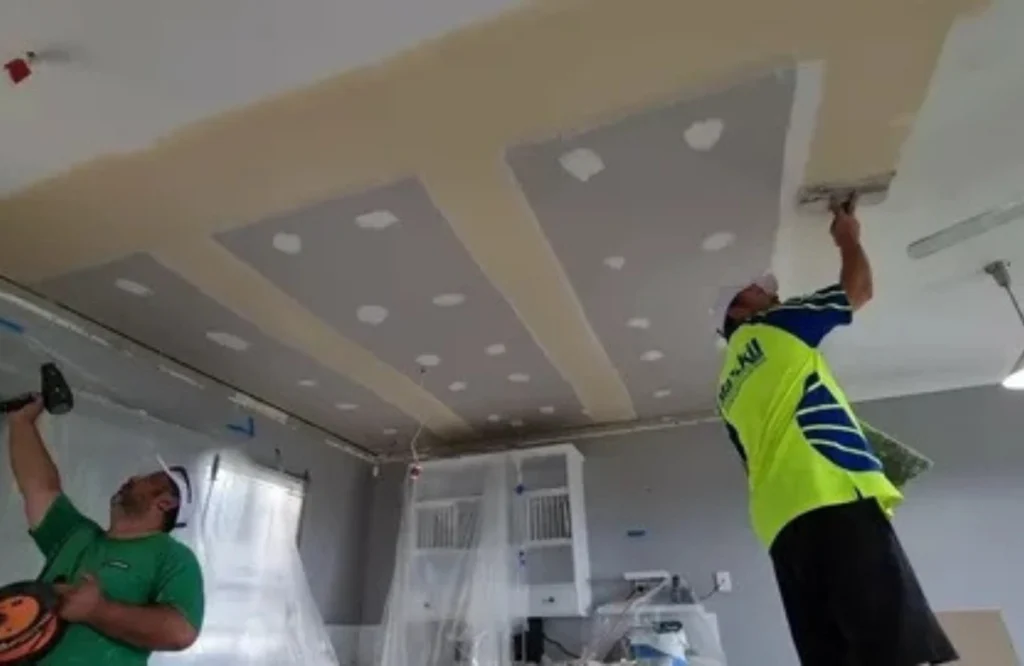
Drywall ceilings that are coated professionally, such as those done by Knapp Painting, are a great way to not only give your facility a professional look, but the coated panels also enhance energy efficiency by increasing brightness up to 33%.
Conclusion
To address the need to meet the safety requirements and provide a comfortable and functional environment, it is necessary to choose the appropriate kind of drywall for factory ceilings. Fire-resistant, moisture-resistant, and soundproof are just some of the examples of drywall types that have their purpose; whether it is the additional safety, countering damp locations, or noise protection.
FAQs
When the spans of the factory ceilings are large (more than 24 inches), and the weights carried by the ceiling design include heavy items such as lighting or ducts, 5/8 drywall should be used. The rigidity is offered by this thickness to ensure that deflection limits are met and to avoid sagging due to vibrations or humidity. Thinner 1/2-inch ones are only effective in low areas.
Ceilings should have no more than 12-inch spacing of drywall screws. Fire-rated assemblies might require a smaller spacing, which is often 8 inches. Local building codes and manufacturer requirements should be used to check the specific requirements, depending on the type of drywall and framing applied.
In damp factories (greater than 70 percent RH), such as food processing plants, use moisture-resistant (MR) greenboard, cement board, or glass mat-faced (GFRG) drywall.